Small businesses that actively manage their sales pipeline close up to 28% more deals — here’s exactly how to build and run yours.
Why Most Small Business Sales Pipelines Fail Before They Start
According to a 2024 HubSpot Sales Report, nearly 40% of small business owners say they have no formal sales process in place. They rely on gut instinct, sticky notes, and memory to track potential customers — and then wonder why revenue feels unpredictable month after month.
If you’ve ever lost track of a hot prospect, forgotten to follow up, or watched a deal go cold without knowing why, your pipeline is the problem — not your product.
In this guide, you’ll learn exactly what a sales pipeline is, why it matters for your bottom line, and how to build one from scratch — even if you’re running your business solo or with a small team. We’ll cover the stages, the numbers you need to track, the tools that actually help, and the mistakes that silently kill deals before they close.
By the end, you’ll have a clear, actionable framework to turn your sales process from reactive chaos into a predictable revenue engine.
What Is a Sales Pipeline and How Does It Work?
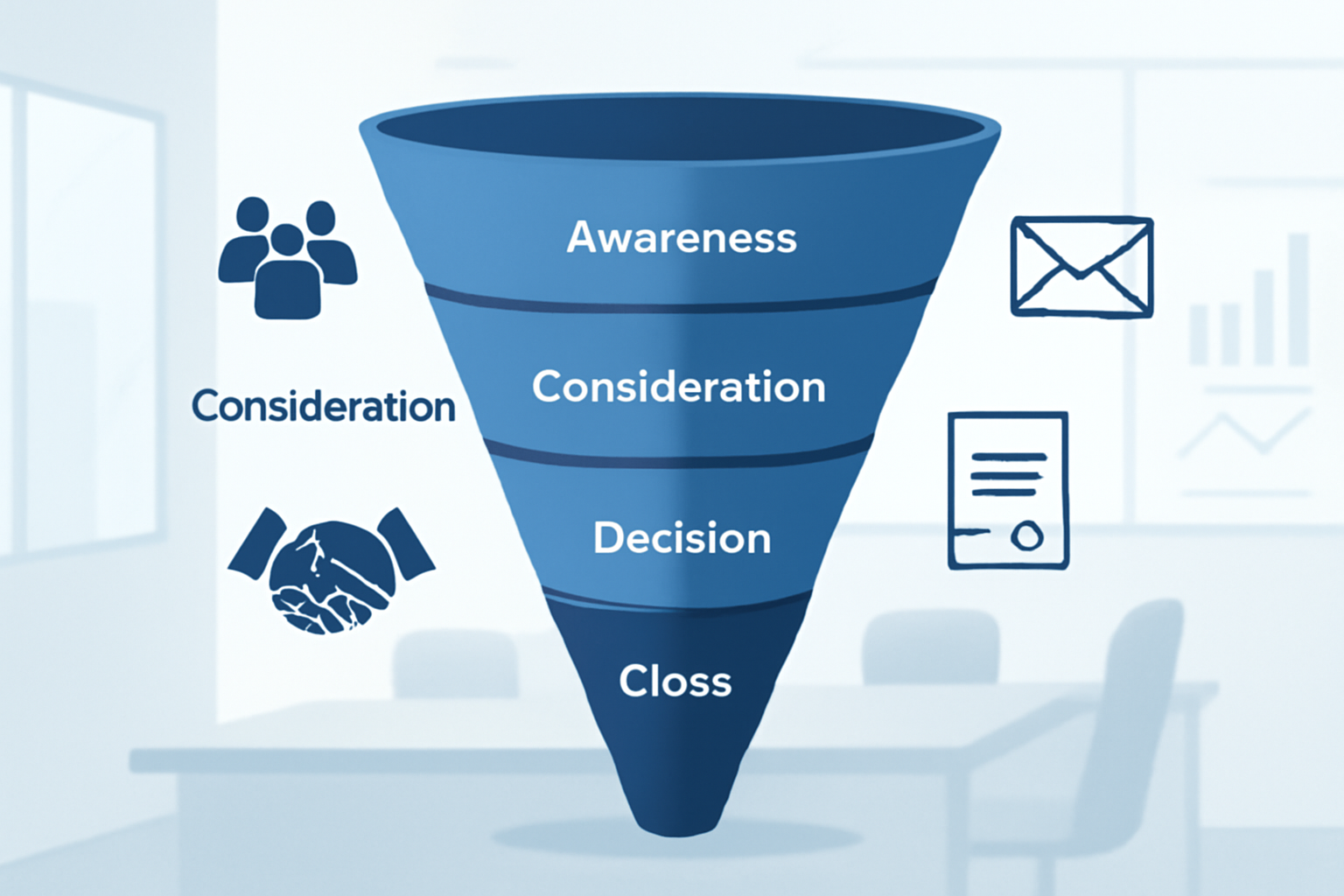
A sales pipeline is a visual representation of where every potential customer (called a prospect or lead) stands in your buying process — from first contact all the way to a closed deal.
Think of it like a funnel with defined stages. At the top, you have a large pool of leads. As you qualify, nurture, and engage them, fewer move forward — but those who do are increasingly likely to buy.
Each stage represents a specific action or milestone. A typical pipeline for a small business might look like this:
- Lead generation — Someone shows initial interest (fills out a form, calls in, attends a webinar)
- Qualification — You confirm they have the budget, need, and authority to buy
- Discovery / Needs assessment — You learn about their specific problem
- Proposal / Quote sent — You present your offer and pricing
- Negotiation — Objections are handled, terms are discussed
- Closed — Won or Lost — Deal is finalized or prospect exits
The key difference between a pipeline and a general to-do list: every deal in a pipeline has a dollar value, a probability of closing, and an expected close date attached to it. That’s what makes it a financial forecasting tool, not just a checklist.
According to Salesforce’s 2024 State of Sales report, businesses with clearly defined pipeline stages are 33% more likely to hit their revenue targets. For small businesses operating on thin margins, that difference is not academic — it’s make-or-break.
Key Benefits of a Managed Sales Pipeline
Beyond organization, a well-managed pipeline delivers measurable financial advantages that compound over time.
Predictable revenue forecasting. When you know how many deals are in each stage and their average close rates, you can estimate next month’s revenue with reasonable accuracy. This helps you make smarter hiring, inventory, and cash flow decisions. For more on managing cash flow effectively alongside your pipeline, see our guide on CRM for Small Business Sales: How to Close More Deals.
Shorter sales cycles. Research from CSO Insights shows that companies with a defined pipeline process reduce their average sales cycle by up to 18%. When you know exactly what needs to happen at each stage, deals don’t stall in limbo.
Higher close rates. A 2023 Pipedrive report found that sales reps who consistently update their pipeline data close 28% more deals than those who don’t. Visibility creates accountability.
Smarter resource allocation. You stop wasting time on leads that will never buy and double down on prospects that are genuinely close to a decision. For a solo owner-operator, this is the difference between a 60-hour week and a 45-hour one.
Better coaching and performance tracking. If you have a sales team, the pipeline shows you exactly where each rep is struggling — whether it’s generating leads, converting proposals, or handling objections — so you can coach them specifically rather than generically.
How to Build Your Sales Pipeline Step by Step
Building a pipeline doesn’t require expensive software on day one. You need a clear process first — the tools come after. Here’s how to get started:
Step 1: Define Your Pipeline Stages
Map your actual sales process — not an idealized version. Interview your best customers and ask what steps they went through before buying. Document every consistent touchpoint. Typically, 5 to 7 stages work best for small businesses. Too many stages create administrative burden; too few, and you lose visibility.
Step 2: Set Entry and Exit Criteria for Each Stage
A deal moves from "Qualified Lead" to "Proposal Sent" only when a specific action has occurred — not when you hope it has. Define these triggers clearly. For example: a deal enters the Proposal stage only after a discovery call has been completed and a budget range has been confirmed.
Step 3: Calculate Your Baseline Metrics
You need four core numbers to run a pipeline effectively:
- Number of deals — How many active opportunities do you have right now?
- Average deal size — What is the typical contract or sale value?
- Win rate — What percentage of qualified leads do you close? Industry average varies, but 20-30% is common in B2B services.
- Average sales cycle length — How many days from first contact to close?
With these four numbers, you can calculate how many new leads you need to generate each month to hit a revenue goal. For example: if your average deal is $5,000, your win rate is 25%, and you want $50,000 in new revenue this month, you need 40 new qualified leads entering your pipeline.
Step 4: Choose Your Pipeline Tool
Start simple. A spreadsheet works for a solo operator with fewer than 20 active deals. Google Sheets or Excel with columns for each pipeline stage, deal owner, value, and expected close date is enough to get started.
As you grow, a CRM (Customer Relationship Management) tool becomes essential. Top options for small businesses include:
- HubSpot CRM — Free tier available, excellent for early-stage businesses
- Pipedrive — Pipeline-first design, starting around $14/user/month
- Zoho CRM — Cost-effective, strong automation features starting at $20/user/month
Our full breakdown is available in the CRM for Small Business Sales guide — it’ll help you pick the right tool for your revenue stage.
Step 5: Schedule Weekly Pipeline Reviews
Block 30-60 minutes every week to review every deal in your pipeline. Ask three questions for each: What happened since last week? What needs to happen next? Is the expected close date still realistic? Deals that haven’t moved in 30 days either need a decisive follow-up or should be archived as "stalled."
Step 6: Build a Follow-Up Cadence
According to the National Sales Executive Association, 80% of sales require at least five follow-up contacts after the initial meeting — yet 44% of salespeople give up after just one follow-up. Build a structured outreach cadence: email on day 1, call on day 3, LinkedIn message on day 7, final email on day 14. Automate what you can using your CRM’s sequence feature.
Costs, Fees, and Risks of Pipeline Management Tools
Pipeline management software ranges from free to several hundred dollars per user per month. Here’s what to expect at each level:
Free tools (HubSpot Free, Zoho Free): Limited deals, contacts, and automations. Fine for solo operators doing under $500K/year in revenue. Risk: you’ll outgrow these quickly.
Mid-tier CRMs ($15-$50/user/month): Pipedrive, Freshsales, Monday CRM. Includes automation, reporting, and integrations. For a 3-person sales team, you’re looking at $540-$1,800/year. This is a business deduction — the IRS allows you to deduct software subscriptions as ordinary business expenses under Section 162.
Enterprise tools ($75-$300+/user/month): Salesforce, Microsoft Dynamics. Overkill for most small businesses. Don’t let a vendor upsell you before you’ve outgrown the mid-tier options.
Hidden risks to watch:
- Data migration pain: Moving pipeline data between tools is time-consuming. Choose a platform you can grow into.
- Adoption failure: A CRM no one uses is worse than a spreadsheet everyone does. Budget for training time.
- Over-automation: Automating outreach before you’ve tested messaging manually can kill deals at scale.
Common Sales Pipeline Mistakes to Avoid
Even smart business owners make these errors — and they’re expensive when you calculate the deals lost.
Mistake 1: Stuffing the pipeline with unqualified leads. A bloated pipeline feels good but lies to you. If you’re tracking 200 "prospects" and only 20 have confirmed budget and need, your pipeline is 90% noise. This distorts your forecasts and wastes follow-up time. Apply strict qualification criteria before a lead enters the pipeline. Use a framework like BANT (Budget, Authority, Need, Timeline) to filter aggressively at the top.
Mistake 2: Not tracking deal velocity. Most owners track how many deals they have — but not how fast they’re moving. A deal stuck in "Proposal Sent" for 60 days isn’t really in play anymore. Set a maximum time limit for each stage. If a deal exceeds it, flag it, follow up decisively, or move it out. Stale deals inflate your pipeline value and create false confidence in forecasts.
Mistake 3: Ignoring lost deal data. Every closed-lost deal is a data point. Why did they say no? Price? Competitor? Timing? Poor fit? Track loss reasons systematically. According to Gartner, companies that analyze lost deal data improve their win rates by an average of 15% within 12 months. A simple dropdown field in your CRM for "Reason Lost" is all you need to start.
Mistake 4: Failing to align pipeline stages with the buyer’s journey. Your stages should reflect what the buyer is doing, not just what you want to track internally. If a stage says "Demo Scheduled" but your buyer hasn’t agreed they have a problem yet, you’re misaligned. Reframe stages around buyer decisions: "Problem Acknowledged," "Solution Evaluated," "Vendor Selected."
Mistake 5: Not tying the pipeline to compensation. If your sales team isn’t rewarded for keeping pipeline data accurate, they won’t. Structure your sales compensation plan to include a pipeline hygiene component — even a small one — so reps have skin in the game.
Alternatives to a Traditional Sales Pipeline
A linear pipeline isn’t the right model for every business. Here are two alternatives worth considering depending on your sales model:
Sales Flywheel Model
Instead of a linear funnel, the flywheel model treats sales, marketing, and customer success as a continuous loop. Satisfied customers generate referrals that feed new leads back in. This works especially well for service businesses with high repeat purchase rates. The tradeoff: it’s harder to assign dollar values to each stage, which makes revenue forecasting less precise.
Account-Based Selling (ABS)
Rather than managing individual deals, ABS focuses on a curated list of high-value target accounts. All energy goes into penetrating those specific companies rather than chasing volume. This is ideal for B2B businesses with average deal sizes above $25,000 and long sales cycles (90+ days). The downside: it requires significant upfront research and a tight alignment between sales and marketing.
Subscription / Product-Led Growth (PLG)
For SaaS or subscription businesses, the pipeline is replaced partly by a self-service model — customers try the product for free, upgrade when they see value. Sales steps in only for enterprise deals. If your business model has a free trial or freemium component, a traditional pipeline may only apply to a segment of your revenue.
Frequently Asked Questions
How many deals should I have in my pipeline at any given time?
Generally speaking, you want 3-5x your monthly revenue goal sitting in qualified pipeline value. If you need $50,000 in closed deals this month and your average win rate is 25%, you need at least $200,000 in active pipeline. Any less and you’re likely to miss your target even if everything goes well.
What’s the difference between a sales pipeline and a sales forecast?
Your pipeline is the full picture of all active opportunities. Your forecast is a subset — the deals you expect to close within a specific timeframe, usually the current quarter or month, weighted by probability. A pipeline is an inventory; a forecast is a prediction derived from it.
How often should I review my pipeline?
At minimum, once a week as a business owner. If you have a sales team, a brief daily standup (10-15 minutes) focusing on deals expected to close within 14 days keeps everyone aligned. Monthly, do a deeper review of pipeline health — win rates, average deal size trends, and stage conversion rates.
Can I build a sales pipeline without a CRM?
Yes — a well-structured spreadsheet works for businesses with fewer than 20 active deals at a time. Google Sheets is free and collaborative. However, once you’re managing more than that, or if you have multiple salespeople, a dedicated CRM pays for itself quickly in time saved and deals that don’t fall through the cracks.
How do I calculate my pipeline conversion rate?
Divide the number of deals won by the total number of deals that entered your pipeline in the same period. For example: if 100 leads entered your pipeline in Q1 and you closed 22, your pipeline conversion rate is 22%. Track this monthly and compare quarter-over-quarter to measure improvement.
Build Your Pipeline Now — Revenue Follows Process
A sales pipeline isn’t a luxury for big companies with large sales teams. It’s the backbone of any business that wants predictable, scalable revenue — and it’s accessible to any small business owner willing to put in the upfront work to build it right.
Start this week: map your current sales stages on paper, pick the four metrics you’ll track, and set a recurring calendar block for your weekly pipeline review. That’s your minimum viable pipeline. From there, layer in a CRM, refine your qualification criteria, and start analyzing your lost deal data.
The businesses that outperform their competitors rarely have better products — they have better processes. Your pipeline is that process made visible and manageable.
If you’re also refining how you attract leads in the first place, pair this with our Social Media Marketing for Small Business guide to fill the top of your pipeline consistently.
This article is for educational purposes only and does not constitute financial, tax, or investment advice. Always consult a licensed financial advisor, CPA, or attorney before making financial decisions.