Sales Prospecting Strategies for Small Business
Businesses that follow a structured prospecting process generate 50% more sales-ready leads at 33% lower cost — here’s how to build yours.
Why Prospecting Is the Lifeblood of Small Business Sales
Picture this: Maria runs a seven-person marketing agency in Austin, Texas. Her business is profitable — but only when her three biggest clients stay happy. The moment one of them pauses their retainer, revenue drops 30% overnight. The root problem isn’t service quality. It’s that Maria stopped prospecting the moment her pipeline looked full.
According to the Rain Group’s 2024 Top-Performing Sales Organization report, 42% of salespeople say prospecting is the hardest part of their job — yet it’s the single activity most directly linked to sustainable revenue growth. For small business owners wearing multiple hats, that difficulty is multiplied by limited time, no dedicated sales team, and often, no clear process at all.
This guide breaks down exactly what sales prospecting is, which methods actually work for small businesses in 2026, how to build a repeatable system from scratch, and the costly mistakes that keep most owners stuck in a feast-or-famine revenue cycle. Whether you sell B2B services, physical products, or software, you’ll leave with an actionable roadmap you can start using this week.
What Is Sales Prospecting and How Does It Work?
Sales prospecting is the process of identifying and reaching out to potential customers — called prospects — who fit your ideal customer profile and have a reasonable chance of buying from you. It’s the very first stage of your sales cycle, happening before demos, proposals, or negotiations.
Prospecting is often confused with lead generation, but there’s a meaningful difference. Lead generation is typically marketing-driven — someone fills out a form on your website or downloads an ebook. Prospecting is sales-driven — you actively identify and contact people who haven’t raised their hand yet.
For small businesses, this distinction matters because you usually can’t afford to wait for inbound leads alone. A proactive prospecting system gives you control over your pipeline and protects you from revenue volatility.
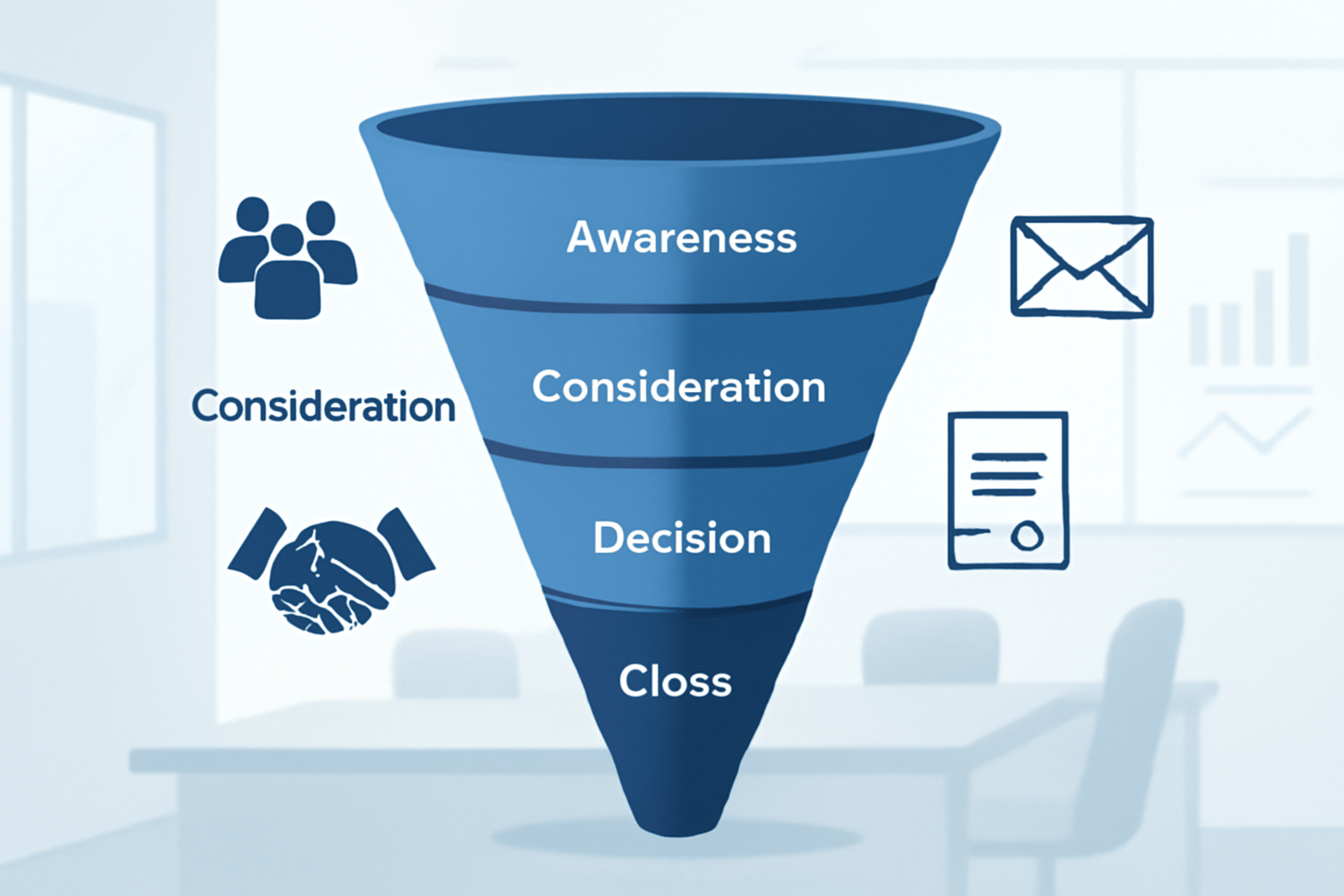
The prospecting process generally follows five steps:
- Define your Ideal Customer Profile (ICP) — industry, company size, geography, budget range, decision-maker title
- Build your prospect list — using LinkedIn, industry directories, trade associations, or existing networks
- Choose your outreach channels — email, phone, LinkedIn, in-person events
- Make contact and qualify — determine if the prospect has the need, budget, and authority to buy
- Move qualified prospects into your sales pipeline — for follow-up, demos, or proposals
The entire goal of prospecting is not to sell — it’s to start a conversation with the right people and determine if a deeper discussion makes sense for both parties.
Key Benefits of a Structured Prospecting Process
A HubSpot 2025 Sales Trends Report found that businesses with a defined prospecting process close 28% more deals annually compared to those relying purely on inbound referrals and word-of-mouth. Here’s why that number is so significant for small business owners specifically.
Predictable Revenue
When you prospect consistently — say, dedicating 90 minutes every weekday — you create a steady flow of new opportunities entering your pipeline. Over time, you can measure your conversion rates and forecast revenue with real accuracy. If you know that 10 cold emails produce one qualified call, and three qualified calls produce one closed deal worth $5,000, your math becomes operational.
Reduced Dependency on Any Single Client
Most small businesses that struggle with cash flow do so because they rely on two or three clients for the majority of their revenue. Consistent prospecting builds a diversified client base that acts as a financial buffer. For deeper insight into protecting your revenue streams, see our guide on Business Revenue Diversification for Small Business.
Lower Customer Acquisition Cost Over Time
Targeted prospecting — reaching only people who match your ICP — reduces wasted effort. You’re not pitching unqualified leads or spending marketing budget on broad audiences. Over time, a refined prospect list dramatically lowers your cost per new customer. For more on optimizing that metric, explore our resource on How to Lower Customer Acquisition Cost for Your Business.
Competitive Intelligence
Active prospecting keeps you in constant conversation with your market. You learn what problems buyers are struggling with right now, what competitors they’re considering, and what objections are most common — intelligence that improves your product, your pitch, and your positioning.
How to Build Your Sales Prospecting System: Step-by-Step
The Bureau of Labor Statistics reports that 20% of small businesses fail within their first year — and lack of consistent sales is one of the top cited reasons. The following process is built to prevent that outcome by giving you a repeatable, scalable prospecting engine.
Step 1: Define Your Ideal Customer Profile (ICP)
Before you prospect anyone, you need clarity on who you’re actually targeting. Your ICP is a detailed description of the type of customer most likely to buy, stay, and refer others.
For a B2B business, your ICP might include: company size (10-50 employees), industry (professional services), annual revenue ($1M-$10M), geography (continental US), decision-maker title (COO or Operations Director), and a specific pain point (manual reporting processes wasting 10+ hours per week).
Review your top 10 existing clients and identify what they have in common. That pattern is the foundation of your ICP.
Step 2: Build a Targeted Prospect List
With your ICP defined, you can build your list using:
- LinkedIn Sales Navigator — filter by title, company size, industry, and geography. Plans start around $99/month but typically pay for themselves quickly with even one closed deal.
- Industry directories and associations — the National Federation of Independent Business (NFIB), trade associations, and chamber of commerce member directories are goldmines.
- ZoomInfo or Apollo.io — databases that provide verified contact information including direct phone numbers and email addresses.
- Google Maps / Yelp — for locally-focused businesses targeting other local businesses.
- Your own network — former colleagues, vendors, and referral partners often know exactly who fits your ICP.
Aim to build a list of at least 100 qualified prospects before launching outreach. Quality matters far more than volume here.
Step 3: Choose Your Primary Outreach Channels
Not every channel works for every business. Here’s a realistic breakdown:
- Cold email — High scalability, low cost, works well for B2B. Industry average open rates hover around 20-25% when properly targeted. Use personalized subject lines and keep the first email under 150 words.
- LinkedIn outreach — Excellent for B2B with longer sales cycles. Connection request followed by a value-first message (not a pitch) tends to outperform generic templates.
- Cold calling — Underused and often overlooked. RAIN Group data shows that 69% of buyers accepted at least one cold call in the past year. Effective when paired with prior email contact.
- In-person events and trade shows — High-cost but high-conversion. Industry conferences often provide the most direct access to decision-makers.
- Referral-based prospecting — The highest-converting channel in virtually every study. Ask satisfied clients for specific introductions, not generic referrals. For a full framework on building this systematically, see our Referral Marketing for Small Business guide.
Step 4: Write Outreach That Gets Responses
The single biggest mistake in prospecting outreach is leading with your product. Effective prospecting messages follow this structure:
- Personalized opener — Reference something specific about the prospect (recent company news, a post they shared, a mutual connection)
- Relevant problem statement — Describe a challenge their type of business commonly faces, not what you sell
- Brief credibility signal — One sentence about who you are and one relevant result you’ve delivered for similar companies
- Low-friction call to action — Ask for a 15-minute call or a simple yes/no question, never a 45-minute demo on the first touch
Step 5: Build a Follow-Up Cadence
Research from Salesforce consistently shows it takes an average of 8 touchpoints to reach a new prospect. Most small business owners give up after 1-2. Build a structured follow-up sequence:
- Day 1: First email or LinkedIn message
- Day 3: Follow-up email with a different angle or piece of value (article, case study)
- Day 7: Phone call attempt
- Day 14: Final email — honest, direct, and respectful of their time
Automate this sequence using tools like Mailshake, Lemlist, or even a free CRM like HubSpot — but never let automation replace genuine personalization.
Step 6: Qualify Before You Pitch
Once a prospect responds, resist the urge to immediately jump into a sales pitch. Use a simple qualification framework like BANT: Does the prospect have the Budget, Authority, Need, and Timeline that make them a real opportunity? This saves you from investing hours in prospects who were never going to buy.
Costs, Fees, and Risks of Different Prospecting Methods
The CFPB notes that small businesses often underestimate the indirect costs of sales activities. Here’s a realistic look at what each prospecting method actually costs — in both money and time.
- LinkedIn Sales Navigator: ~$99-$149/month. ROI depends entirely on your average deal size. Not worth it if your average contract value is under $2,000.
- Apollo.io or ZoomInfo: $50-$250/month depending on plan. Risk: data can be outdated. Always verify emails before bulk sending to protect your domain reputation.
- Cold email at scale: Risk of CAN-SPAM Act violations if you don’t include a physical business address and unsubscribe option. The FTC enforces penalties up to $51,744 per email that violates CAN-SPAM rules.
- Trade shows: $2,000-$20,000+ depending on booth size and conference. High opportunity cost if you go without a clear ICP and follow-up plan.
- Your time: This is your biggest real cost. At $150/hour (a conservative value for a small business owner’s time), 10 hours of weekly prospecting costs $1,500/week. That means you need to close enough deals to justify it — and you will, with a consistent system.
Common Sales Prospecting Mistakes to Avoid
A Gartner study found that 77% of B2B buyers describe their last purchase as extremely complex or difficult. Often, poor prospecting makes the process worse before it even starts. Avoid these critical errors:
Mistake 1: Prospecting Without a Defined ICP
Spraying generic messages to any business with a pulse is the number-one time waster in small business sales. When your ICP isn’t defined, your conversion rates are low, your rejection rates are high, and you burn out fast. Fix: spend two hours reviewing your best clients and building a written ICP before any outreach.
Mistake 2: Treating Prospecting as an Event, Not a System
Many owners prospect intensely when revenue dips, then stop completely when the pipeline fills up — creating the feast-or-famine cycle. This is the most dangerous pattern in small business sales. Fix: block 60-90 minutes every business day for prospecting, regardless of how full your pipeline looks today.
Mistake 3: Pitching Too Early
The first email is not the place to explain your pricing, packages, or features in detail. Buyers tune out immediately when they feel like they’re being sold to before being understood. Fix: your first message should show that you understand their world, not that you want their money.
Mistake 4: Giving Up After One or Two Touches
As noted above, eight touchpoints is the industry average for first contact. Most small business owners stop at two, leaving money on the table. Fix: build and stick to a multi-touch follow-up sequence that respects the prospect’s time while staying consistently visible.
Mistake 5: Failing to Track Your Numbers
If you don’t know your contact-to-call rate, call-to-proposal rate, and proposal-to-close rate, you can’t improve your system. Fix: use a simple spreadsheet or free CRM to track every prospect from first contact to close or disqualification. Review the data monthly.
Alternatives to Cold Prospecting
Cold outreach isn’t the only path to new business. Depending on your situation, these alternatives may deliver stronger ROI.
Inbound Content Marketing
Pros: Attracts prospects who are already interested; builds brand authority over time; lower long-term cost per lead.
Cons: Slow to generate results (typically 6-12 months to gain traction); requires consistent content investment.
Best for: Businesses with a 12+ month runway who can invest in SEO and content now for future payoff.
Strategic Partnerships and Channel Sales
Pros: Access to an existing audience; built-in credibility; faster trust-building.
Cons: Revenue sharing required; dependent on partner’s activity level; risk of misaligned incentives.
Best for: Service businesses that can create complementary, non-competing partnerships — for example, a bookkeeper partnering with a business attorney.
Event-Based Prospecting
Pros: Face-to-face conversations convert at far higher rates than digital outreach; relationship-building is faster.
Cons: High time and money cost; geographically limited; results can be inconsistent.
Best for: Local service businesses or those with high-ticket offerings where one client justifies a $3,000 conference ticket.
Frequently Asked Questions About Sales Prospecting
How many prospects should I contact per week as a small business owner?
Generally speaking, 20-30 new outreach contacts per week is a realistic and sustainable target for a solo owner-operator. That’s 4-6 new contacts per business day — manageable within a 90-minute prospecting block. Scale up once you have a clear system and can measure your conversion rates at each stage.
Is cold email legal for B2B outreach?
Yes, in most cases B2B cold email is legal in the US under CAN-SPAM Act guidelines, as long as you include your business name, a physical mailing address, and an unsubscribe mechanism in every email. Always consult legal counsel if you’re uncertain about your specific situation, particularly if you’re emailing outside the US where GDPR may apply.
How long does it take to see results from a new prospecting system?
Most small businesses see their first qualified conversations within 2-4 weeks of launching a structured prospecting campaign. Closed deals typically follow within 30-90 days, depending on your sales cycle length. Patience and consistency in the first 60 days are critical — the system needs time to generate data you can learn from.
Should I hire someone to do prospecting for me?
Hiring a Sales Development Representative (SDR) or outsourcing to a prospecting agency can make sense once your average deal size exceeds $5,000 and you have a proven message that generates responses. Before that threshold, building the system yourself ensures you understand the market deeply enough to train and manage someone else later.
What’s the best CRM for small business prospecting?
For businesses just getting started, HubSpot CRM (free tier) or Pipedrive ($15-25/user/month) are widely used and well-reviewed. The best CRM is the one your team will actually use consistently — features matter far less than adoption. Avoid over-engineering your tech stack before you have a steady volume of prospects to manage.
Conclusion: Build the Habit Before You Need the Results
Sales prospecting is one of the highest-leverage activities a small business owner can invest time in — but only when done with a clear system, a defined target, and the discipline to keep going even when the pipeline looks full. The businesses that grow consistently aren’t necessarily better at closing deals. They’re better at finding the right conversations to have in the first place.
Start this week by doing three things: write your Ideal Customer Profile, build a list of 50 qualified prospects, and draft your first outreach message. Don’t wait until everything is perfect. A good system executed consistently will always outperform a perfect system that never gets off the ground.
As with any business strategy, your results will depend on your specific market, offer, and execution. Consult with a business advisor or sales coach who can review your specific situation before making significant investments in tools or team members.
This article is for educational purposes only and does not constitute financial, tax, or investment advice. Always consult a licensed financial advisor, CPA, or attorney before making financial decisions.