
Tag: business growth

  • How to Find a Business Partner: A Practical Guide

    How to Find a Business Partner: A Practical Guide

    How to Find a Business Partner: A Practical Guide

    Entrepreneurs who launch with the right co-founder are 2x more likely to successfully scale — here’s how to find yours without the costly mistakes.

    Why Choosing the Right Business Partner Is a High-Stakes Decision

    According to a 2025 Harvard Business School study, nearly 65% of startup failures stem from co-founder conflict — not bad products or lack of funding. That’s a sobering number, especially if you’re currently thinking about bringing someone on board to help grow your business.

    If you’ve ever watched a promising venture unravel because two owners stopped seeing eye-to-eye, you already know this risk is real. Whether you’re a solo entrepreneur looking for operational support or a small business owner who needs a partner with complementary skills, the decision to bring someone into your company deserves the same rigor you’d apply to any major financial investment.

    In this guide, you’ll learn exactly where to find a business partner in the US, what to look for before you commit, how to structure the relationship legally, and which red flags to avoid. Think of this as your step-by-step roadmap to making one of the most important calls of your entrepreneurial journey.

    What Is a Business Partner and How Does the Arrangement Work?

    A business partner is someone who shares ownership, responsibilities, and — depending on your structure — liability in a business venture. This is different from hiring an employee or bringing on a contractor. A partner typically holds an equity stake, meaning they own a percentage of the business and are entitled to a share of profits and losses.

    In the US, business partnerships are commonly structured in one of three ways:

    • General Partnership (GP): Both partners share equal management responsibilities and personal liability for business debts.
    • Limited Partnership (LP): One partner manages operations (general partner) while others contribute capital but have limited liability (limited partners).
    • LLC with Multiple Members: Partners form a Limited Liability Company together, protecting personal assets while sharing ownership. This is the most popular structure for small business co-ownership today.

    The IRS treats partnerships as pass-through entities, meaning profits and losses flow directly to the partners’ individual tax returns — a critical detail when planning your finances. According to the IRS, there were over 4.2 million partnership returns filed in the US in 2024, reflecting just how common this arrangement remains.

    Knowing the structure options upfront allows you to have informed conversations with potential partners before either of you commits to anything.

    Key Benefits of Having the Right Business Partner

    When the fit is right, a business partnership can be one of the most powerful accelerators for your company’s growth. Here’s what you stand to gain:

    Complementary skill sets. If you’re strong in sales and marketing but weak in operations or finance, a partner who fills those gaps can dramatically reduce your risk. Research from Startup Genome found that startups with two co-founders raise 30% more investment capital than solo founders.

    Shared financial burden. Starting or scaling a business requires capital. A partner can contribute funds, which reduces how much you need to borrow or give up to outside investors. According to the Federal Reserve’s 2025 Small Business Credit Survey, 43% of small business applicants cited insufficient collateral as a barrier to funding — sharing the load with a partner can ease that pressure.

    Accountability and resilience. Running a business solo can be isolating. A good partner provides a built-in sounding board, keeps you accountable, and helps carry the emotional weight during difficult stretches — a factor that’s often underestimated but consistently cited by successful entrepreneurs.

    Operational continuity. If you get sick, need time off, or face a personal emergency, a partner ensures the business doesn’t come to a standstill. This is especially important for service-based businesses and client-facing operations.

    The key word throughout all of this is right. A mismatched partner erases every one of these benefits and introduces new, expensive problems.

    How to Find a Business Partner: Step-by-Step

    Finding a trustworthy, aligned business partner doesn’t happen by accident. Here’s a proven process you can follow:

    1. Define what you need before you search. Write out your own strengths and weaknesses honestly. Then list the specific skills, industry experience, and personality traits you need in a partner. Don’t start looking until you know what you’re looking for.
    2. Tap your professional network first. According to SCORE, a national nonprofit supported by the US Small Business Administration (SBA), over 70% of successful business partnerships begin within existing professional circles — former colleagues, clients, or industry peers. Start there before looking at strangers.
    3. Use co-founder matching platforms. Platforms like CoFoundersLab, Indie Hackers, and Founder2be are designed specifically to connect entrepreneurs. LinkedIn is also a powerful tool — search for professionals in your industry and reach out with a specific, well-crafted message about what you’re building.
    4. Attend entrepreneurship events and accelerators. Organizations like your local SBA office, SCORE chapter, or regional Chamber of Commerce regularly host events that bring entrepreneurs together. Incubators and accelerators like Y Combinator, Techstars, and 500 Startups also facilitate co-founder connections through their programs.
    5. Run a trial period before formalizing anything. Before signing any legal documents, work together on a defined project for 60 to 90 days. Pay attention to how they handle pressure, communicate, and follow through on commitments. This trial period is non-negotiable.
    6. Conduct thorough due diligence. Check references. Look at their financial history if the business will involve shared finances. Run a background check through a reputable service. Ask hard questions about past business relationships and why they ended.
    7. Hire a business attorney to draft a partnership agreement. This document should cover equity split, roles and responsibilities, decision-making authority, compensation, buy-sell provisions (what happens if one partner wants out), and dispute resolution processes. The cost of a solid partnership agreement — typically $1,500 to $5,000 — is a fraction of what a legal dispute costs later. For LLC formation guidance, see our full breakdown on Small Business Exit Strategy: How to Plan Your Way Out.

    Costs, Fees, and Risks You Need to Understand

    A business partnership is not without its costs — financial and otherwise. Here’s what to budget for and watch out for:

    Legal fees: Drafting a partnership agreement or LLC operating agreement with a business attorney typically costs between $1,500 and $5,000 depending on complexity and your location. Skipping this step to save money is one of the most expensive mistakes entrepreneurs make.

    Equity dilution: Giving up equity means giving up future profits. If your business eventually sells for $2 million and your partner holds 40%, that’s $800,000 they walk away with. Know exactly what you’re offering before negotiations begin.

    Tax complexity: Partnership tax returns (Form 1065) are more complex than sole proprietor filings. You’ll likely need a CPA, which can add $500 to $2,500 or more annually to your accounting costs depending on business complexity.

    Personal liability in a general partnership: In a standard general partnership, both partners are personally liable for business debts and legal judgments. This means your personal assets — home, savings, car — could be at risk if things go wrong. Forming an LLC instead provides a layer of protection.

    Relationship risk: If the partnership breaks down, you may face legal disputes, loss of key operational knowledge, and damage to customer relationships. Having a well-structured buyout clause in your agreement is your best protection. You may also want to revisit our guide on Small Business Exit Strategy for planning ahead.

    Common Mistakes to Avoid When Choosing a Business Partner

    The most costly partnership mistakes are almost always avoidable. Watch out for these:

    1. Partnering based on friendship alone. Friendship and business compatibility are two entirely different things. Just because you trust someone personally doesn’t mean you share the same work ethic, financial risk tolerance, or vision for the company. Many friendships have been permanently destroyed by business partnerships that weren’t built on professional alignment.

    2. Skipping a formal partnership agreement. A handshake deal or a vague email chain is not a legally binding agreement. Without a formal document, disputes about profit distribution, ownership percentage, and exit terms become expensive legal battles. The SBA strongly recommends all business partnerships be formalized in writing before any money changes hands.

    3. Splitting equity 50/50 without thinking it through. A 50/50 split sounds fair but creates a deadlock risk — if you and your partner disagree on a major decision and neither holds controlling interest, the company can grind to a halt. Consider slight adjustments (51/49) or include a formal tie-breaking process in your agreement.

    4. Ignoring financial red flags. If a potential partner has a history of unpaid debts, failed businesses with unresolved creditor disputes, or poor personal credit, those signals matter. According to the CFPB, financial stress is one of the leading contributors to business partner disputes. Do your homework.

    5. Failing to align on long-term vision. If you want to build a lifestyle business and your partner wants to scale fast and sell in five years, that misalignment will eventually blow up the relationship. Have the hard conversations about exit goals, growth pace, and reinvestment strategy before you start — not two years in.

    Alternatives to a Traditional Business Partner

    A full equity partnership isn’t always the right move. Depending on your situation, one of these alternatives might serve you better:

    Key hire instead of a partner. If you need operational support but aren’t ready to give up equity, hiring a highly skilled employee or executive — possibly with a performance-based bonus or small profit share — can fill the gap without the legal complexity of a partnership. This is often the right call in the early stages when cash flow is tight.

    Business advisor or fractional executive. Many experienced entrepreneurs and executives offer fractional services — meaning they work with your company part-time for a monthly retainer. A fractional CFO, COO, or CMO can bring the expertise you need without permanent equity commitment. Retainers typically range from $2,000 to $10,000 per month depending on the role and scope.

    Strategic joint venture. Instead of merging ownership in a single entity, two businesses can form a joint venture for a specific project or market opportunity. This allows you to leverage another company’s resources, distribution, or expertise without giving up equity in your core business. Joint ventures are governed by a separate agreement and are time-limited or project-specific.

    Each of these alternatives has trade-offs. A hire costs salary but preserves ownership. A fractional executive costs cash but offers flexibility. A joint venture requires careful legal structuring. Evaluate which model matches your current growth stage and financial position.

    Frequently Asked Questions

    Q: What percentage of equity should I give a business partner?
    A: There’s no universal answer, but equity should reflect each partner’s contribution — capital invested, skills brought, risk assumed, and time committed. Common splits range from 50/50 to 70/30. Work with a business attorney to model out scenarios before making an offer.

    Q: How do I protect myself if a partnership goes bad?
    A: A well-drafted partnership or LLC operating agreement with a buyout clause is your primary protection. Include provisions for how a departing partner’s shares are valued and purchased, and add a non-compete clause to prevent a former partner from immediately competing against you.

    Q: Can I find a business partner online?
    A: Yes — platforms like CoFoundersLab, LinkedIn, and Indie Hackers are widely used. However, vet every candidate thoroughly. Treat it like a hiring process with background checks, reference calls, and a trial work period before formalizing anything.

    Q: Do I need a lawyer to form a business partnership?
    A: Technically no, but practically yes. The IRS and most states have minimal formal requirements to create a general partnership, but the absence of a legal agreement is the single biggest source of costly disputes. Always hire a business attorney to draft your agreement.

    Q: How is a business partnership taxed in the US?
    A: Partnerships file an informational return using IRS Form 1065, and each partner receives a Schedule K-1 showing their share of income, deductions, and credits. Each partner then reports their K-1 income on their individual tax return. Partners are also subject to self-employment tax on their share of business income. Consult a CPA for your specific tax situation.

    The Bottom Line: Choose Your Business Partner Like You’d Choose a Business

    Finding the right business partner is one of the highest-leverage decisions you’ll make as an entrepreneur. Done well, it can double your chances of success, accelerate growth, and make the journey significantly less lonely. Done poorly, it can cost you years of effort, thousands of dollars in legal fees, and — in the worst cases — your business itself.

    The process requires honest self-assessment, disciplined vetting, a formal legal agreement, and clear alignment on the big-picture vision. Don’t rush it. Don’t let friendship override professional judgment. And don’t skip the paperwork.

    Your next step: write out your own skill gaps and business goals this week. Then look at your existing professional network for two or three people who fill those gaps. That’s where most great partnerships begin. And if you’re building your financial infrastructure as you grow, check out our guide on Best Business Credit Cards for Small Business in 2026 to make sure your funding tools are in place.

    Consulting a business attorney and a CPA before finalizing any partnership arrangement is strongly recommended — the upfront cost is always less than the cost of fixing a poorly structured deal.


    Financial Disclaimer: This article is for educational purposes only and does not constitute financial, tax, or investment advice. Always consult a licensed financial advisor, CPA, or attorney before making financial decisions.

  • Sales Compensation Plans: How to Build One That Works

    Sales Compensation Plans: How to Build One That Works

    Sales Compensation Plans: How to Build One That Works

    The right sales compensation plan can increase revenue by up to 44% — here’s how to design one your team will actually perform for.

    Why Your Sales Comp Plan Might Be Costing You Money Right Now

    According to a 2025 report from the Sales Management Association, nearly 58% of small business owners say their current sales compensation structure either underperforms or actively drives away top talent. That’s a staggering number — and if you’ve ever watched a strong salesperson walk out the door to a competitor, you already know the pain.

    Here’s the hard truth: a poorly designed sales compensation plan doesn’t just fail to motivate your team. It can quietly drain your cash flow, reward the wrong behaviors, and create a culture of resentment — all while your top performers start updating their LinkedIn profiles.

    In this guide, you’ll learn exactly how to build a sales compensation plan that attracts great salespeople, drives the right behaviors, and scales with your business. We’ll cover the most common structures, real-world numbers, IRS tax implications, and the costly mistakes most small business owners make before they get this right.

    Whether you’re setting up your first sales team or fixing a broken comp structure, this guide will give you a clear framework to move forward with confidence.

    What Is a Sales Compensation Plan and How Does It Work?

    A sales compensation plan is a documented structure that defines how your salespeople earn money — including base salary, commission rates, bonuses, and any performance incentives. It’s the financial contract between your business and your sales team, and it signals exactly what you value and what you’re willing to pay for.

    There are two core components in most plans:

    • Fixed pay: A guaranteed base salary regardless of performance
    • Variable pay: Commission, bonuses, or incentives tied directly to results

    The mix between fixed and variable pay is often called the pay mix. For example, a 60/40 pay mix means 60% of a salesperson’s on-target earnings (OTE) come from base salary and 40% come from hitting their quota.

    According to the Bureau of Labor Statistics, the median annual wage for sales representatives in the US was approximately $68,000 in 2025 — but total compensation including commissions can easily reach $90,000 to $130,000+ for high performers in B2B industries.

    Your comp plan matters because it directly affects who you attract, how hard they work, and how long they stay. Get it right, and it becomes your most powerful growth tool. Get it wrong, and it’s a slow leak in your revenue pipeline.

    Key Benefits of a Well-Designed Sales Compensation Plan

    A strong compensation structure does far more than just pay your salespeople. When designed well, it works as a strategic tool that aligns individual behavior with your company’s goals.

    1. It drives the right behaviors. If you pay commission only on new accounts, your team will focus on new accounts — sometimes at the expense of existing customers who generate recurring revenue. Your comp plan should reward the activities that actually grow your business sustainably.

    2. It reduces costly turnover. The average cost of replacing a sales rep is estimated at 150% to 200% of their annual salary, according to research from Glassdoor and SHRM. When salespeople feel fairly compensated and see a clear path to earning more, they stay longer — saving you significant recruiting and training costs.

    3. It gives you a competitive recruiting edge. Top sales talent has options. A transparent, generous comp plan with realistic quotas can be the deciding factor when a strong candidate is choosing between you and a larger competitor.

    4. It creates predictable revenue forecasting. When you understand what quota attainment looks like at different performance levels, you can model your revenue projections more accurately — which also helps with business cash flow management.

    A 2024 study by Xactly Corp found that companies with clearly documented comp plans saw 14% higher quota attainment rates compared to those with informal or inconsistent structures. That’s a meaningful lift that compounds over time.

    The Most Common Sales Compensation Structures

    Before you build your plan, you need to choose the right structure for your business model, sales cycle, and team size. Here are the six most common models used by US small businesses:

    1. Straight Salary

    Salespeople earn a fixed salary with no commission. This works well for long sales cycles, highly technical products, or roles where team selling makes individual attribution difficult. The downside: it removes the performance incentive that makes great salespeople shine.

    2. Straight Commission

    Reps earn only what they sell — no base salary. This can attract highly motivated hunters, but it creates income instability that drives turnover and can discourage reps from investing time in long-term relationship building. Generally speaking, this model works best for independent contractors rather than full-time employees.

    3. Base Salary Plus Commission (Most Common)

    This hybrid model is the most widely used structure in US small businesses. Reps get security from a base and upside from commission. A common structure: $45,000–$60,000 base with a 5%–15% commission rate on closed deals. This balances stability with strong performance incentives.

    4. Tiered Commission

    Commission rates increase as reps hit higher performance thresholds. For example: 5% on the first $100K in sales, 8% on $100K–$250K, and 12% on anything above $250K. This structure rewards your top performers disproportionately and encourages reps to push past their quota — not just reach it.

    5. Revenue Share

    Reps earn a percentage of total revenue from their accounts, including renewals. This is common in SaaS and subscription businesses where customer lifetime value matters more than a single transaction.

    6. Bonus-Based Plans

    Reps earn a base salary plus quarterly or annual bonuses tied to hitting team or individual targets. Less common as a primary comp model, but frequently used as a supplement to commission-based plans.

    For most small business owners building a sales team for the first time, the base salary plus tiered commission model offers the best balance of motivation, stability, and alignment with business goals. If you’re still building your initial B2B sales funnel, start simple and add complexity as you scale.

    How to Build Your Sales Compensation Plan: Step-by-Step

    Here’s a practical framework you can implement in your business, even if you’re starting from scratch:

    1. Define your on-target earnings (OTE). OTE is the total compensation a rep earns when they hit 100% of quota. Research your local market using Glassdoor, LinkedIn Salary, and the BLS to find competitive OTE ranges for your role and industry. In most US markets, B2B sales reps expect OTE between $65,000 and $110,000 depending on industry and experience.
    2. Set your pay mix. Decide the ratio of base to variable pay. A common starting point for small business inside sales is 70/30 (70% base, 30% variable). For more aggressive field sales roles, 50/50 or even 40/60 is reasonable.
    3. Establish realistic quotas. A quota should be achievable for roughly 60%–70% of your team — not a stretch goal only your best rep can hit. Industry benchmarks suggest quota should be 4x to 6x the rep’s OTE for most B2B businesses.
    4. Define your commission rate. Work backwards: if OTE is $90,000 with a 60/40 mix, variable pay at quota is $36,000. If quota is $500,000 in annual revenue, your commission rate is approximately 7.2%.
    5. Add performance accelerators. Consider paying higher commission rates (accelerators) when reps exceed quota. For example, 1.5x the standard rate for everything above 100% of quota. This is the strongest motivator for top performers.
    6. Set your commission payment schedule. Most small businesses pay commissions monthly or quarterly. Avoid paying too far after the close — it weakens the psychological connection between effort and reward. The IRS treats commissions as supplemental wages, subject to a flat 22% federal withholding rate (or your normal payroll rate if added to regular pay).
    7. Document everything. Create a clear, signed comp plan agreement for each rep. Include quota, rate, payment timing, clawback provisions, and what happens if a deal is cancelled or refunded. Ambiguity here is where lawsuits start.

    Costs, Fees, and Tax Implications to Know

    Your comp plan doesn’t just affect your top line — it has real tax and cash flow implications you need to plan for carefully.

    Payroll taxes: For W-2 employees, you’ll owe employer-side FICA taxes (7.65%) on base salary and commissions. For a rep earning $85,000 total, that’s roughly $6,500 in employer payroll taxes annually per employee.

    Commission clawbacks: If a customer cancels or defaults, will you require reps to return commissions already paid? Clawback provisions are legal in most US states but must be clearly documented in the comp agreement. Failing to do this can cost you significantly if a large deal falls through post-commission payment.

    1099 vs. W-2 classification: The IRS has strict rules about worker classification. Misclassifying an employee as an independent contractor to avoid payroll taxes can result in back taxes, penalties, and interest. Generally speaking, if you control when, where, and how someone works, they’re likely an employee — consult a CPA before classifying anyone as a contractor.

    Draw against commission: Some businesses offer a recoverable draw — a guaranteed minimum payment that reps pay back from future commissions. This helps with rep cash flow during ramp-up but creates accounting complexity and potential disputes if a rep leaves before repaying.

    If cash flow is a concern while scaling your sales team, review your business line of credit options to ensure you can fund payroll during growth phases without creating operational stress.

    Common Mistakes to Avoid When Setting Up Sales Comp

    These are the errors that cost small business owners the most — both in money and in talent:

    Mistake #1: Setting unrealistic quotas. If fewer than 50% of your reps consistently hit quota, the quota is wrong — not the reps. Unachievable quotas destroy morale, increase turnover, and signal to candidates that your comp plan is misleading. Review quota attainment quarterly and adjust when market conditions shift.

    Mistake #2: Overcomplicating the plan. If a rep can’t calculate their paycheck on a napkin, the plan is too complex. Complicated comp plans create distrust, reduce motivation, and generate constant disputes. Start simple: one or two metrics, a clear rate, a predictable schedule.

    Mistake #3: Ignoring the ramp period. New reps take 3–6 months to reach full productivity. If you put them on full quota from day one, you’ll lose them before they’ve learned your product. Build in a ramp schedule — for example, 50% of quota in month 1, 75% in month 2, 100% from month 3 onward.

    Mistake #4: Not documenting clawback and cancellation policies. This is one of the most common sources of legal disputes between small businesses and sales reps. Always define upfront: what happens to commissions if a deal is cancelled, refunded, or never paid by the customer?

    Mistake #5: Paying commission on revenue instead of gross profit. If your margins vary significantly across products or services, a revenue-based commission incentivizes reps to sell whatever closes fastest — not necessarily what’s most profitable for your business. Consider paying commission on gross profit instead to align incentives with business health.

    Alternatives to Traditional Sales Compensation Models

    If a traditional salary-plus-commission model doesn’t fit your business, here are three alternatives worth considering:

    1. Profit-sharing plans. Instead of individual commissions, reps participate in a company-wide profit pool based on overall business performance. This promotes collaboration and long-term thinking but can reduce individual motivation for top performers. Under IRS rules, qualified profit-sharing plans have annual contribution limits of up to 25% of eligible compensation.

    2. Equity or phantom equity. For early-stage businesses that can’t yet compete on cash compensation, offering equity (or phantom equity — a cash bonus tied to company value milestones) can attract senior sales talent willing to bet on growth. This requires careful legal documentation and is most common in venture-backed startups.

    3. Referral and partnership programs. If you’re not ready to build a full internal sales team, a structured referral or affiliate partner program can generate qualified leads at a fraction of the cost. Commission rates for referral partners typically range from 5% to 20% of deal value, depending on the level of involvement in the sale.

    Frequently Asked Questions

    What is a good commission rate for a small business sales rep?
    Commission rates vary widely by industry, but for B2B small businesses, 5%–12% of gross revenue is a common range. SaaS and subscription businesses often pay 8%–15% on first-year revenue, plus residuals on renewals. Work backwards from your OTE target and quota to land on a rate that’s competitive and financially sustainable.

    How often should I pay sales commissions?
    Monthly is the most common payment schedule and offers the best balance between administrative simplicity and keeping reps motivated. Quarterly works for longer sales cycles. Avoid paying commissions only once a year — the disconnect between work and reward is too large to be motivating.

    Should I use W-2 employees or 1099 contractors for sales?
    In most cases, sales reps who work exclusively for your company, follow your processes, and use your tools will be classified as W-2 employees under IRS guidelines. Misclassification as a 1099 contractor can result in significant tax penalties. Consult a CPA or employment attorney before making this decision.

    What is a draw against commission?
    A draw is an advance against future commissions — essentially a guaranteed minimum payment during ramp-up. A recoverable draw must be paid back from future commissions. A non-recoverable draw does not. Most small businesses use recoverable draws for the first 60–90 days only.

    How do I know if my comp plan is working?
    Track three core metrics: quota attainment rate (target: 60%–70% of reps hitting quota), sales rep turnover rate (industry benchmark: under 25% annually), and time-to-productivity for new hires. If any of these metrics are significantly off-target, your comp plan likely needs adjustment.

    The Bottom Line: Your Comp Plan Is a Growth Strategy

    A well-built sales compensation plan is one of the highest-leverage investments a small business owner can make. It doesn’t just pay your salespeople — it shapes culture, drives behavior, attracts talent, and ultimately determines how fast your business grows.

    Start with a simple, transparent structure. Set realistic quotas. Pay competitively for your market. Build in accelerators that reward your best performers. And document everything clearly so there’s no ambiguity when big commissions are on the line.

    Review your comp plan at least once a year — ideally before each new fiscal year — and adjust for changes in your market, team size, and product mix. The best comp plans evolve as your business grows.

    Take the time to get this right, and your sales team will become your most powerful competitive advantage.

    This article is for educational purposes only and does not constitute financial, tax, or investment advice. Always consult a licensed financial advisor, CPA, or attorney before making financial decisions.

  • B2B Sales Funnel: How to Build and Optimize Yours

    B2B Sales Funnel: How to Build and Optimize Yours

    B2B Sales Funnel: How to Build and Optimize Yours

    Companies that optimize their B2B sales funnel see up to 36% higher win rates — here’s exactly how to build one that converts.

    Why Your B2B Sales Funnel Is the Backbone of Revenue

    According to the Harvard Business Review, companies with a clearly defined sales process generate 18% more revenue than those operating without one. Yet, a 2025 Salesforce report found that nearly 68% of small business owners in the US have never formally mapped their sales funnel — they’re just winging it and hoping deals close.

    If you’re a small business owner or sales manager, that statistic should stop you cold. A B2B sales funnel isn’t just a buzzword. It’s the structured path that turns a complete stranger into a paying client — and then keeps that client coming back.

    In this guide, you’ll learn exactly what a B2B sales funnel is, how to build one from scratch, which metrics actually matter, where most funnels leak money, and how to fix the most common mistakes. Whether you’re closing $20,000 contracts or $200,000 deals, the framework works the same way.

    This is for educational purposes — consult a licensed financial advisor or business consultant for personalized guidance.

    What Is a B2B Sales Funnel and How Does It Work?

    A B2B sales funnel (business-to-business sales funnel) is a model that maps every stage a potential business client moves through — from the moment they first hear about you to the moment they sign a contract and beyond.

    Unlike B2C (business-to-consumer) purchases, B2B sales cycles are typically longer, involve multiple decision-makers, and require significantly more trust-building before money changes hands. The average B2B sales cycle in the US lasts 84 days, according to a 2025 Gartner study — and for deals above $50,000, that number often stretches past six months.

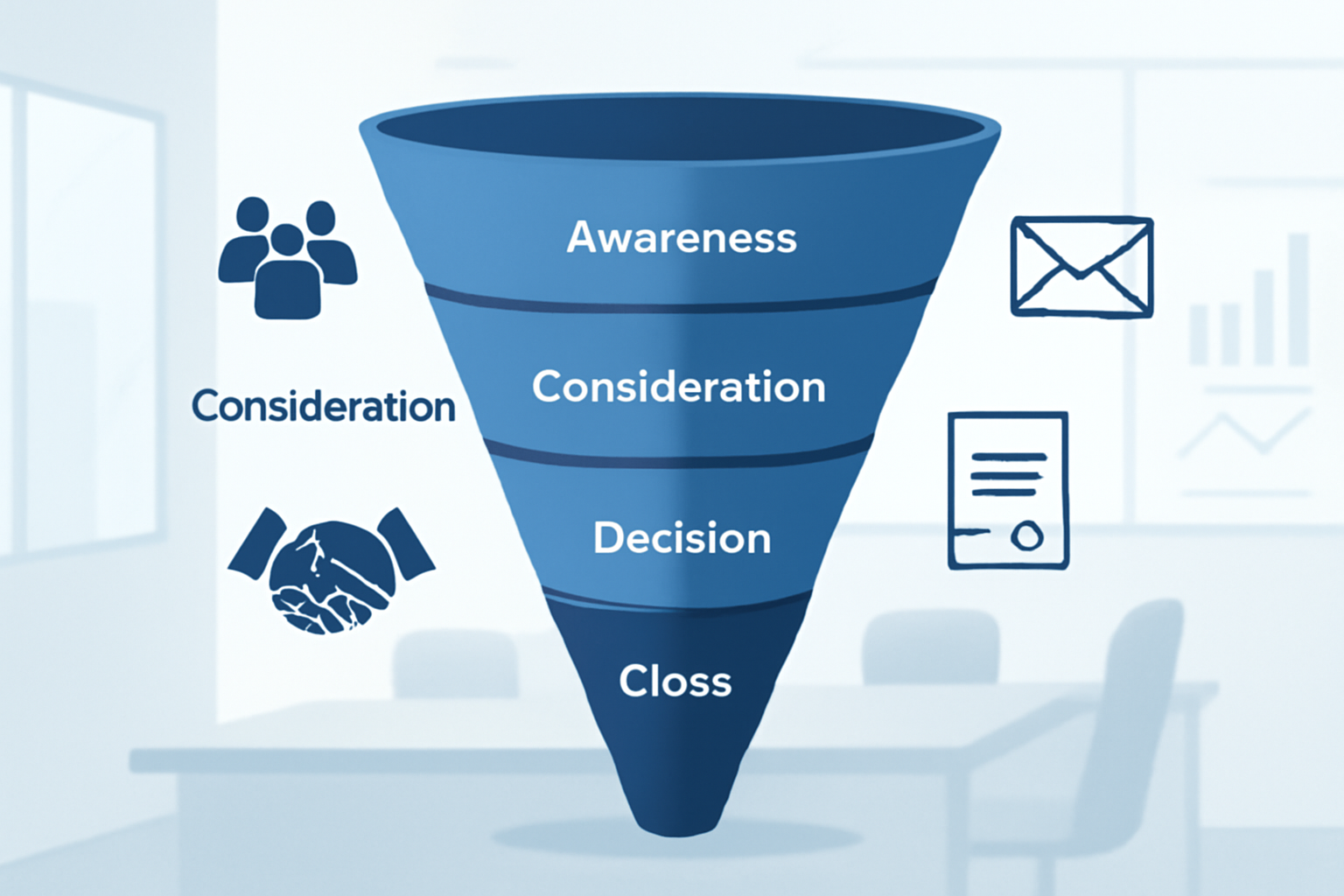
    The funnel is usually broken into four core stages:

    • Awareness: The prospect learns your business exists.
    • Interest/Consideration: They actively research your solution.
    • Decision: They evaluate you against competitors and negotiate terms.
    • Action/Close: They sign, pay, and become a customer.

    Some models add a fifth stage — Retention and Expansion — which is where the most profitable B2B companies make their real money through upsells, renewals, and referrals.

    Understanding which stage each prospect is in tells you exactly what message to send, what content to show them, and how urgently to follow up.

    Key Benefits of Optimizing Your Sales Funnel

    Here’s the business case for taking your funnel seriously. A 2024 McKinsey report found that B2B companies with optimized sales funnels achieve 2.9x higher revenue growth compared to industry peers who rely on ad hoc selling.

    Let’s break down what that looks like in practical, dollar terms for a small business:

    Shorter sales cycles: When prospects receive the right information at the right stage, they make decisions faster. A business closing 10 deals per quarter at a $15,000 average contract value that cuts its cycle from 90 days to 60 days effectively frees up cash flow and capacity to pursue more deals.

    Higher conversion rates: The average B2B lead-to-close conversion rate hovers around 3-5% across industries (Salesforce, 2025). Funnel optimization can realistically push that to 8-12% — potentially doubling revenue without increasing your marketing budget.

    Better forecasting: When you know how many leads enter each funnel stage and what percentage advance, you can predict monthly revenue with real accuracy. That kind of visibility is critical when managing payroll, inventory, or applying for a business line of credit.

    Reduced customer acquisition cost (CAC): Disorganized sales efforts waste time on unqualified prospects. A defined funnel filters leads early so your team spends energy where it actually converts to revenue.

    How to Build Your B2B Sales Funnel: Step-by-Step

    Building a funnel that works isn’t complicated — but it does require intentional design at every stage. Here’s a practical, numbered process you can apply to your business starting this week.

    Step 1: Define Your Ideal Customer Profile (ICP)

    Before you build anything, you need to know exactly who you’re selling to. Your ICP should include company size (employee count, annual revenue), industry vertical, decision-maker job title, geography, and the specific pain point your product or service solves.

    For example: “CFOs at manufacturing companies with $5M–$50M in annual revenue located in the Midwest who are struggling with cash flow forecasting.” The more specific, the better your funnel will perform.

    Step 2: Map Your Lead Sources

    Identify where your best clients currently come from. Common B2B lead sources include LinkedIn outreach, inbound content marketing (blog, SEO), referrals, trade shows, email campaigns, and paid ads. Your funnel needs a steady stream at the top — without leads entering, nothing else matters.

    If you haven’t invested in content as a lead source, a content marketing strategy for small businesses can generate qualified inbound leads at a fraction of the cost of paid advertising over time.

    Step 3: Create Stage-Specific Content and Touchpoints

    Each funnel stage needs different content:

    • Awareness: Blog posts, LinkedIn articles, podcast appearances, paid ads
    • Consideration: Case studies, comparison guides, webinars, email sequences
    • Decision: Proposals, demos, ROI calculators, client testimonials, reference calls
    • Retention: Onboarding materials, quarterly business reviews, upsell offers

    Step 4: Set Up a CRM

    A Customer Relationship Management (CRM) tool is non-negotiable. Tools like HubSpot (free tier available), Salesforce, or Pipedrive let you track every prospect’s stage, set follow-up reminders, and measure conversion rates between stages. Without a CRM, your funnel exists only in people’s heads — and deals fall through the cracks constantly.

    Step 5: Define Your Follow-Up Cadence

    Studies from the National Sales Executive Association show that 80% of sales require five or more follow-up contacts after an initial meeting — yet 44% of salespeople give up after just one follow-up. Build a structured sequence: initial outreach, follow-up at 3 days, 7 days, 14 days, and 30 days, each with a different angle or value add.

    Step 6: Measure and Adjust Monthly

    Track these core funnel metrics every month: number of new leads, lead-to-opportunity rate, opportunity-to-proposal rate, proposal-to-close rate, average deal size, and average sales cycle length. Identify your weakest stage and focus improvement efforts there first.

    Costs, Fees, and Risks of Building a Sales Funnel

    Building a B2B sales funnel isn’t free, and it’s important to understand the real investment involved. According to the U.S. Bureau of Labor Statistics, small businesses typically allocate 7-12% of gross revenue to sales and marketing combined — and sales funnel infrastructure is a major component of that spend.

    CRM software: HubSpot’s free plan covers basics, but paid plans start at $20/month per seat and scale to $1,200+/month for enterprise features. Salesforce starts around $25/user/month for basic functionality. Budget $100–$500/month for a small sales team.

    Content and lead generation: Producing quality content, running LinkedIn ads, or hiring an SDR (Sales Development Representative) all carry real costs. LinkedIn lead gen campaigns can run $8–$15 per click in competitive B2B categories.

    Time investment: The hidden cost most business owners underestimate. Building a proper funnel, training your team, and iterating based on data takes dozens of hours upfront — time that comes from somewhere else in your business.

    Risks: Over-engineering your funnel early is a real danger. Too many stages, too much automation, or an overly complex CRM setup can actually slow your team down. Start simple. Also, be cautious about investing heavily in paid lead generation before you’ve validated that your funnel can actually close the leads it receives — burning ad spend on a leaky funnel is a costly mistake.

    Common Mistakes That Kill B2B Sales Funnels

    Most sales funnels don’t fail because of bad products. They fail because of predictable, fixable errors. Here are the most damaging ones — and how to avoid them.

    Mistake #1: Treating every lead the same. Not all leads are created equal. Sending a bottom-of-funnel product demo to someone who just downloaded a top-of-funnel awareness blog post will kill the relationship. Segment your leads by stage and send stage-appropriate communication. Skipping this step is one of the most expensive errors in B2B sales.

    Mistake #2: Neglecting the follow-up. As mentioned above, most B2B deals close after five or more touchpoints. If your team stops following up after one or two unanswered emails, you’re leaving significant revenue on the table. Build automated follow-up sequences in your CRM so no lead goes cold by accident.

    Mistake #3: Unclear qualification criteria. If your sales team doesn’t know what a “qualified” lead looks like, they’ll waste hours on prospects who can’t or won’t buy. Define your minimum qualifying criteria — budget, authority, need, and timeline (commonly known as BANT) — and apply them at the top of the funnel to protect your team’s time.

    Mistake #4: Ignoring post-sale retention. The bottom of the funnel is often completely ignored. A 2024 Bain & Company study found that increasing customer retention by just 5% can increase profits by 25–95%. If you’re focused only on acquiring new clients and not on keeping existing ones happy, you’re building a leaky bucket — spending to fill the top while clients exit the bottom.

    Mistake #5: No written funnel documentation. If your sales process lives only in one person’s head, your business is fragile. Document every stage, every touchpoint, every script, and every piece of content. This enables hiring, training, and consistent execution across your team.

    Alternatives to a Traditional Sales Funnel

    The classic linear funnel model isn’t the only framework available. Depending on your business model and market, one of these alternatives might serve you better — or complement your existing funnel.

    The Flywheel Model: Popularized by HubSpot, the flywheel replaces the linear funnel with a circular model centered on customer delight. Happy customers generate referrals, which feed awareness, which generates new leads organically. This model works best for businesses with strong recurring revenue or subscription models. Pro: Reduces CAC dramatically over time. Con: Takes longer to gain momentum and requires exceptional customer service infrastructure.

    Account-Based Marketing (ABM): Instead of generating many leads and filtering them down, ABM identifies a specific list of high-value target accounts and markets directly to decision-makers within those companies. According to the ITSMA, 87% of B2B marketers say ABM delivers higher ROI than other marketing approaches. Pro: Highly efficient for large deal sizes. Con: Resource-intensive and requires tight sales and marketing alignment.

    Referral-Based Sales System: For many small businesses, the most cost-effective “funnel” is a structured referral program — systematically asking current clients for introductions to their networks. This requires a formal process: asking at the right moment (typically 60–90 days into a successful engagement), offering clear incentives where appropriate, and tracking referral sources. Pro: Lowest CAC of any channel. Con: Hard to scale beyond a certain revenue level without supplementing with outbound or inbound strategies.

    If you’re in the early stages of business development, a solid business plan can help you determine which sales model aligns best with your growth goals and capital structure.

    Frequently Asked Questions

    How long does it take to build a B2B sales funnel?
    Generally speaking, a basic funnel with a CRM, defined stages, and initial content can be set up in 2–4 weeks. A fully optimized funnel with tested messaging, automated sequences, and measurable conversion rates typically takes 3–6 months of iteration. Don’t expect perfection on day one — the funnel improves as you collect data.

    How many leads do I need at the top of my funnel?
    This depends on your conversion rate and revenue goal. If your average deal size is $10,000, your close rate is 5%, and you need $500,000 in annual revenue, you need 1,000 qualified leads per year — roughly 83 per month entering the top of your funnel. Work backward from your revenue target to calculate your required lead volume.

    What’s the best CRM for a small business sales funnel?
    For most small businesses (1–10 person sales teams), HubSpot’s free or Starter tier offers strong value. Pipedrive ($14–$99/month per user) is excellent for teams focused purely on sales pipeline management. Salesforce is powerful but typically overkill and overpriced for businesses under $5M in revenue. The best CRM is the one your team will actually use consistently.

    At what point should I hire a dedicated salesperson?
    In most cases, hiring a dedicated salesperson makes financial sense when your own sales activities are consistently generating more qualified leads than you can personally follow up on, or when your revenue is sufficient to support a base salary plus commission — typically around $80,000–$120,000 in total compensation for an experienced B2B sales rep. Until then, systematizing your own outreach is usually more cost-effective.

    Can I automate my entire B2B sales funnel?
    Partially, yes — but be careful. Email sequences, lead scoring, CRM updates, and appointment scheduling can all be automated effectively. However, the high-value conversations, discovery calls, and proposal stages in B2B sales require genuine human engagement. Over-automating those interactions often signals inauthenticity and costs you deals. Use automation to handle the administrative weight, not to replace relationship-building.

    Build the Funnel, Close More Deals

    A well-designed B2B sales funnel is one of the highest-leverage investments a small business can make. It brings consistency, predictability, and scalability to what often feels like a chaotic, relationship-dependent revenue stream.

    Start with the basics: define your ICP, map your lead sources, set up a CRM, and build stage-specific follow-up sequences. Measure your conversion rates monthly and fix the weakest link in the chain first. Avoid the common traps — treating all leads the same, abandoning follow-up too early, and neglecting retention after the sale.

    Most importantly, remember that a funnel is never truly finished. The best sales organizations treat it as a living system that improves with every closed deal and every lost opportunity analyzed.

    Take one step today: open a spreadsheet or free HubSpot account and map the last 10 deals you closed. Where did they come from? How long did they take? That’s your funnel in its current form — and it’s your starting point for something significantly more powerful.


    Financial Disclaimer: This article is for educational purposes only and does not constitute financial, tax, or investment advice. Always consult a licensed financial advisor, CPA, or attorney before making financial decisions.

  • Content Marketing for Small Business: A Complete Guide

    Content Marketing for Small Business: A Complete Guide

    Content Marketing for Small Business: A Complete Guide

    Small businesses that blog consistently generate 126% more leads than those that don’t — here’s how to build a strategy that actually works.

    Why Content Marketing Is One of the Smartest Moves You Can Make

    If you’re a small business owner, you’ve probably heard that you need to "do content marketing." But between running operations, managing employees, and keeping customers happy, it’s easy to push it to the back burner.

    Here’s the reality: according to the Content Marketing Institute’s 2025 report, businesses that invest in content marketing see conversion rates nearly six times higher than those that don’t. For a company spending $500 a month on content versus $2,000 on paid ads, the long-term ROI often favors content — by a wide margin.

    In this guide, you’ll learn exactly what content marketing is, why it matters for small businesses in the US, and how to build a lean, effective strategy without a big agency budget. Whether you run a local service business, an e-commerce store, or a B2B consultancy, the framework here applies to you.

    By the end, you’ll have a clear roadmap — from picking topics to measuring results — so you can stop guessing and start growing.

    What Is Content Marketing and How Does It Work?

    Content marketing is the practice of creating and distributing valuable, relevant information — blog posts, videos, podcasts, social media posts, email newsletters — to attract and retain a clearly defined audience, with the goal of driving profitable customer action.

    That’s the textbook definition. In plain English: instead of interrupting people with ads, you earn their attention by helping them solve real problems. Over time, that trust turns into sales.

    Here’s how the funnel typically works for a small business:

    • Awareness: A potential customer searches "how to waterproof a basement in Chicago." They find your blog post. They’ve never heard of you before.
    • Consideration: They read two more posts, sign up for your email list to get a free checklist.
    • Decision: Three weeks later, they call your waterproofing company because they already trust you.

    This process takes time — typically three to six months before you see significant organic traffic — but the leads it generates are warmer and cheaper than paid alternatives.

    According to HubSpot’s 2025 State of Marketing report, inbound leads driven by content cost 61% less than outbound leads from cold calls or display advertising. For budget-conscious small business owners, that number matters.

    Key Benefits of Content Marketing for Small Businesses

    Let’s be specific about what content marketing actually delivers, so you can decide if it’s the right investment for your business right now.

    1. Compounding organic traffic. Unlike a paid ad that stops the moment you stop paying, a well-optimized blog post keeps working. A post published today could drive traffic five years from now. Moz’s research shows that top-ranking content pages receive traffic for an average of two or more years after publication.

    2. Lower customer acquisition costs (CAC). The Bureau of Labor Statistics reports that US small businesses spend an average of 7-8% of gross revenue on marketing. Content marketing helps you stretch that budget further — a $300 blog post can generate hundreds of leads over its lifetime.

    3. Builds trust in a skeptical market. The Edelman Trust Barometer consistently shows that consumers trust businesses more when they provide useful information without an obvious sales pitch. This is especially critical for service businesses where trust is the deciding factor.

    4. Improves your SEO automatically. Google rewards websites that consistently publish authoritative, helpful content. More quality content means more keyword rankings, which means more free clicks from search engines.

    5. Supports your entire sales funnel. From awareness-stage blog posts to decision-stage case studies, content works at every level. A single well-crafted FAQ page can reduce the number of repetitive calls your team handles every week.

    If you’re also evaluating how content marketing fits into a broader business growth plan, it’s worth reading our guide on how to write a business plan that gets funded — content strategy is a key section that investors and lenders increasingly look for.

    How to Build a Content Marketing Strategy Step by Step

    Here’s a practical, no-fluff framework you can implement even if you’re a one-person operation.

    Step 1: Define Your Audience and Their Pain Points

    Before you write a single word, get crystal clear on who you’re talking to. Create a simple customer profile: age, job title or life situation, biggest frustrations, and what they Google when they need help. The more specific, the better.

    Example: Instead of "small business owners," target "HVAC contractors in the Southeast US who want to get off the slow season rollercoaster."

    Step 2: Do Keyword Research (Even on a Free Budget)

    Use free tools like Google Search Console, Google Trends, or the free tier of Ubersuggest to find what your audience is actually searching for. Focus on "long-tail" keywords — three to five word phrases like "best CRM for HVAC companies" — because they have lower competition and higher buyer intent.

    Aim for keywords with monthly search volume between 200 and 2,000. Going after terms with 100,000+ monthly searches as a new site is a losing battle against established domains.

    Step 3: Choose Your Primary Content Channel

    You don’t need to be everywhere. Pick one primary channel based on your strengths and where your audience spends time:

    • Blog / SEO content — Best for long-term organic traffic. Good for service businesses, B2B companies, and e-commerce.
    • YouTube — Best for demonstrating expertise visually. Contractors, coaches, and educators do well here.
    • Email newsletter — Best for retention and repeat purchases. Excellent for any business with an existing customer base.
    • LinkedIn — Best for B2B businesses targeting professionals and decision-makers.

    Master one channel before expanding. Spreading yourself thin is one of the most common and costly mistakes small business owners make with content.

    Step 4: Create a Realistic Content Calendar

    Consistency beats volume. Two high-quality blog posts per month published reliably will outperform eight posts in January and nothing until June. Use a simple spreadsheet with publish dates, topics, target keywords, and assigned writers (even if that’s just you).

    A starter cadence for most small businesses: one to two pieces of long-form content (1,200+ words) per month, plus two to four shorter social posts per week repurposing that content.

    Step 5: Optimize Every Piece for Search and Conversion

    Every blog post should have a clear target keyword in the title and first paragraph, a meta description under 160 characters, internal links to related pages, and a call to action (CTA) — whether that’s booking a call, downloading a checklist, or signing up for your email list.

    Don’t skip the CTA. Content without a conversion path is just charity.

    Step 6: Measure, Adjust, and Repeat

    Use Google Analytics 4 (free) to track which posts drive the most traffic, time on page, and conversions. Review your data monthly. Double down on what works. Update or retire what doesn’t. Content marketing is an iterative process, not a set-it-and-forget-it system.

    Costs, Fees, and Real Investment Expectations

    Let’s talk money, because content marketing isn’t free — even when you do it yourself.

    DIY approach: Your primary cost is time. Writing a solid 1,500-word blog post takes most business owners three to five hours. If your time is worth $100/hour, that’s $300-$500 per post. Factor that honestly into your ROI calculations.

    Freelance writers: Rates vary widely. According to the Editorial Freelancers Association’s 2024 rate survey, experienced US-based freelance writers charge $0.20 to $1.00 per word for business content. A quality 1,500-word post typically costs $300 to $800. Avoid "content mills" charging $0.02/word — the quality is almost always too poor to rank or convert.

    Content marketing agencies: Full-service agencies typically charge $2,500 to $10,000+ per month for strategy, writing, SEO, and distribution. This may make sense once you’re generating $500,000+ in annual revenue, but is often overkill for early-stage businesses.

    Tools: Budget $50 to $200 per month for a basic stack: an SEO tool (Ahrefs Lite, Semrush, or Ubersuggest), an email marketing platform (Mailchimp or ConvertKit), and a scheduling tool if you’re active on social media.

    Tax note: Generally speaking, content creation costs — writing fees, software subscriptions, and related tools — are deductible as ordinary business expenses under IRS rules. Consult your CPA to confirm what applies to your specific situation.

    If cash flow is a concern while scaling your marketing investment, it may be worth exploring a business line of credit as a flexible way to fund growth initiatives without tying up working capital.

    Common Content Marketing Mistakes Small Businesses Make

    Avoiding these errors can save you months of wasted effort and thousands of dollars.

    Mistake 1: Writing for yourself instead of your customer. Business owners often create content about what they find interesting, not what their customers are searching for. A plumbing company that writes about the history of pipe materials will get far less traffic than one that writes "Why is my water pressure low? 6 common causes and fixes." Always start with the customer’s question, not your own expertise.

    Mistake 2: Expecting results in 30 days. SEO-driven content typically takes three to six months to gain traction. Business owners who quit after six weeks almost always cite "content marketing doesn’t work" — when in reality, they just didn’t give it enough time. Set realistic milestones: some traffic in months three and four, measurable leads by month six.

    Mistake 3: Ignoring existing content. Updating and improving a post that’s already ranking on page two of Google is often faster and cheaper than writing something new. A Backlinko study found that updating old content can increase organic traffic by an average of 106%. Schedule quarterly content audits as part of your routine.

    Mistake 4: Skipping the email list. Social media algorithms change constantly. Your email list is the only audience you truly own. Even a small list of 500 engaged subscribers is more valuable than 5,000 passive social media followers. Start collecting emails from day one.

    Mistake 5: No clear call to action. Every piece of content should move the reader toward a next step. If someone finishes your article and just closes the tab, you’ve lost them. Whether it’s a free guide download, a consultation booking, or a newsletter signup, tell readers exactly what to do next.

    Alternatives to Traditional Content Marketing

    Content marketing isn’t the only path to customer acquisition. Here are three alternatives worth considering based on your budget and timeline.

    1. Paid Search (Google Ads)
    Pros: Generates leads immediately, highly targeted, easy to measure ROI.
    Cons: Expensive — average cost-per-click in the small business services category ranges from $2 to $15+ according to WordStream’s 2025 industry benchmarks. Stops working the moment you pause spending. Best for businesses that need leads now and have the margin to support it.

    2. Social Media Advertising (Meta, LinkedIn)
    Pros: Excellent audience targeting, works well for visual products and B2C services.
    Cons: Ad fatigue is real, and creative needs constant refreshing. LinkedIn ads are particularly expensive at $5-$15 per click for B2B audiences. Best for businesses with strong visual branding or targeting a narrow professional demographic.

    3. Referral and Partnership Marketing
    Pros: Zero or very low cost, high trust factor, strong conversion rates.
    Cons: Slow to scale, not predictable, depends heavily on relationship quality.
    Best for local service businesses and B2B companies with strong existing networks. A referral program — even something as simple as a $50 gift card per referred client — can be one of your highest-ROI marketing channels.

    In most cases, the ideal approach combines content marketing for long-term organic growth with one paid channel for short-term lead generation, while always investing in referral relationships.

    Frequently Asked Questions

    How long does it take to see results from content marketing?
    Realistically, three to six months for meaningful organic traffic, and six to twelve months for significant lead generation from SEO-driven content. Social media and email content can produce faster results — often within weeks — but typically at smaller scale. Patience and consistency are the two non-negotiables.

    How much should a small business spend on content marketing?
    The US Small Business Administration suggests allocating 7-8% of gross revenue to marketing overall. Of that, many experts recommend directing 20-30% toward content creation and SEO. For a business generating $300,000 in annual revenue, that’s roughly $4,200 to $7,200 per year — or $350 to $600 per month — dedicated to content.

    Do I need to hire a writer or can I do it myself?
    Both work, depending on your skills and time. If writing comes naturally and you can carve out three to four hours per week, DIY content can be highly effective — especially because you bring authentic expertise. If writing is painful or time is your constraint, hiring a quality freelance writer (and briefing them thoroughly on your business) is often a worthwhile investment.

    What type of content gets the best results for local businesses?
    For local SEO, location-specific content performs best: "Best [service] in [city]" pages, neighborhood guides, and locally relevant case studies. Google Business Profile posts also drive significant local visibility and are free to publish. According to BrightLocal’s 2025 Local Consumer Review Survey, 87% of consumers read online reviews before choosing a local business — so review generation should be part of your content strategy too.

    Is blogging still worth it in 2026?
    Yes — with an important caveat. Generic, thin content is less effective than ever as Google’s algorithms have become significantly better at identifying low-quality material. But well-researched, genuinely helpful long-form content continues to rank and convert. The bar is higher, which actually works in your favor if you’re willing to invest in quality. Businesses that publish substantive, authoritative content consistently still see strong organic growth.

    The Bottom Line: Start Small, Stay Consistent, Think Long-Term

    Content marketing isn’t a quick fix — but few legitimate business growth strategies are. The businesses that win with content are the ones that commit to a simple, consistent strategy and give it enough time to compound.

    Start with one channel. Pick two or three topics your customers genuinely search for. Publish consistently, even if that means just one quality post per month in the beginning. Build your email list from day one. And measure what’s working every 90 days so you can refine as you go.

    The compounding effect of good content is one of the most powerful — and underused — assets a small business can build. Two years from now, you’ll either wish you started today, or be glad you did.

    As always, consult a licensed marketing professional or business advisor before committing significant budget to any single marketing channel.


    Financial Disclaimer: This article is for educational purposes only and does not constitute financial, tax, or investment advice. Always consult a licensed financial advisor, CPA, or attorney before making financial decisions.