B2B Sales Funnel: How to Build and Optimize Yours
Companies that optimize their B2B sales funnel see up to 36% higher win rates — here’s exactly how to build one that converts.
Why Your B2B Sales Funnel Is the Backbone of Revenue
According to the Harvard Business Review, companies with a clearly defined sales process generate 18% more revenue than those operating without one. Yet, a 2025 Salesforce report found that nearly 68% of small business owners in the US have never formally mapped their sales funnel — they’re just winging it and hoping deals close.
If you’re a small business owner or sales manager, that statistic should stop you cold. A B2B sales funnel isn’t just a buzzword. It’s the structured path that turns a complete stranger into a paying client — and then keeps that client coming back.
In this guide, you’ll learn exactly what a B2B sales funnel is, how to build one from scratch, which metrics actually matter, where most funnels leak money, and how to fix the most common mistakes. Whether you’re closing $20,000 contracts or $200,000 deals, the framework works the same way.
This is for educational purposes — consult a licensed financial advisor or business consultant for personalized guidance.
What Is a B2B Sales Funnel and How Does It Work?
A B2B sales funnel (business-to-business sales funnel) is a model that maps every stage a potential business client moves through — from the moment they first hear about you to the moment they sign a contract and beyond.
Unlike B2C (business-to-consumer) purchases, B2B sales cycles are typically longer, involve multiple decision-makers, and require significantly more trust-building before money changes hands. The average B2B sales cycle in the US lasts 84 days, according to a 2025 Gartner study — and for deals above $50,000, that number often stretches past six months.
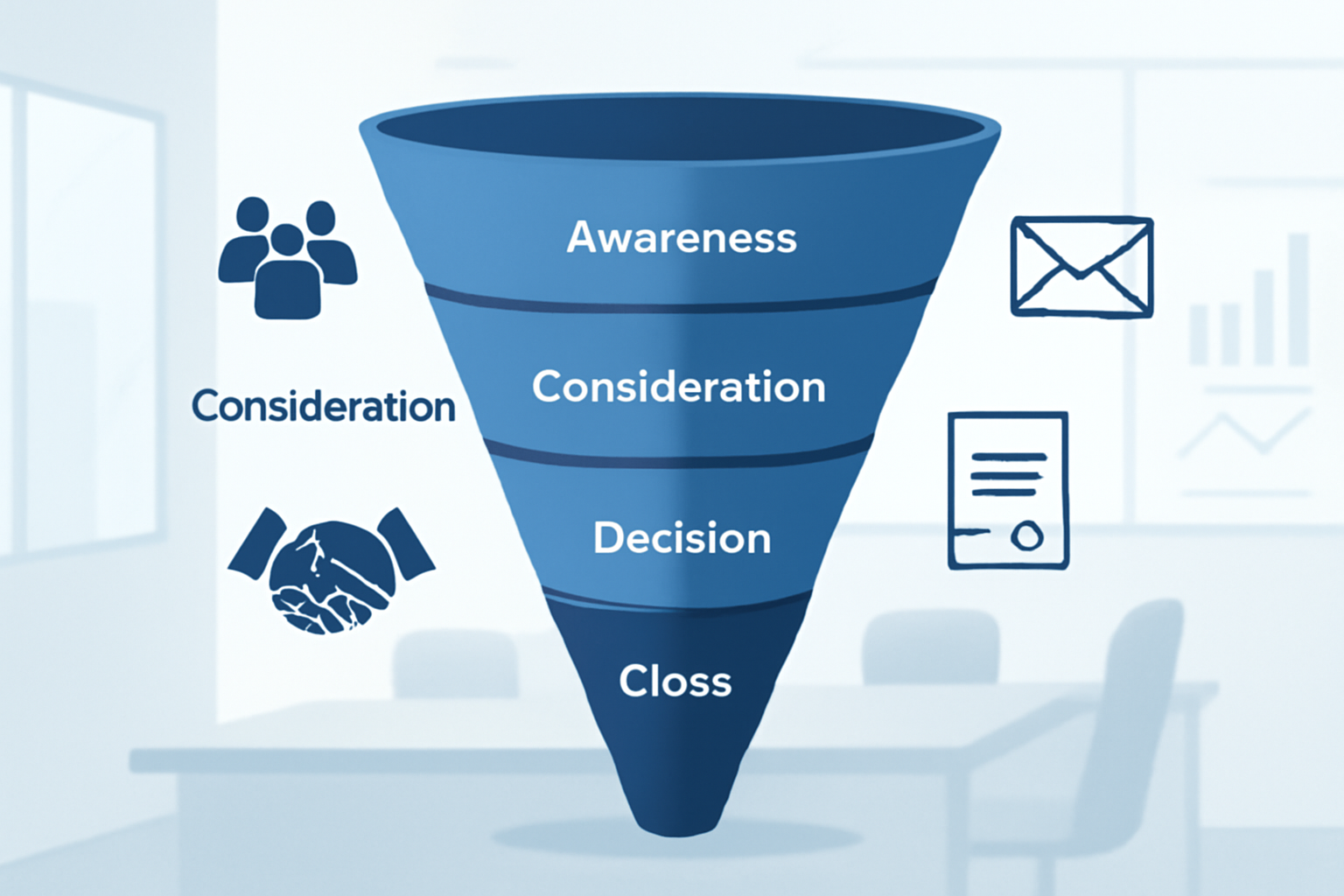
The funnel is usually broken into four core stages:
- Awareness: The prospect learns your business exists.
- Interest/Consideration: They actively research your solution.
- Decision: They evaluate you against competitors and negotiate terms.
- Action/Close: They sign, pay, and become a customer.
Some models add a fifth stage — Retention and Expansion — which is where the most profitable B2B companies make their real money through upsells, renewals, and referrals.
Understanding which stage each prospect is in tells you exactly what message to send, what content to show them, and how urgently to follow up.
Key Benefits of Optimizing Your Sales Funnel
Here’s the business case for taking your funnel seriously. A 2024 McKinsey report found that B2B companies with optimized sales funnels achieve 2.9x higher revenue growth compared to industry peers who rely on ad hoc selling.
Let’s break down what that looks like in practical, dollar terms for a small business:
Shorter sales cycles: When prospects receive the right information at the right stage, they make decisions faster. A business closing 10 deals per quarter at a $15,000 average contract value that cuts its cycle from 90 days to 60 days effectively frees up cash flow and capacity to pursue more deals.
Higher conversion rates: The average B2B lead-to-close conversion rate hovers around 3-5% across industries (Salesforce, 2025). Funnel optimization can realistically push that to 8-12% — potentially doubling revenue without increasing your marketing budget.
Better forecasting: When you know how many leads enter each funnel stage and what percentage advance, you can predict monthly revenue with real accuracy. That kind of visibility is critical when managing payroll, inventory, or applying for a business line of credit.
Reduced customer acquisition cost (CAC): Disorganized sales efforts waste time on unqualified prospects. A defined funnel filters leads early so your team spends energy where it actually converts to revenue.
How to Build Your B2B Sales Funnel: Step-by-Step
Building a funnel that works isn’t complicated — but it does require intentional design at every stage. Here’s a practical, numbered process you can apply to your business starting this week.
Step 1: Define Your Ideal Customer Profile (ICP)
Before you build anything, you need to know exactly who you’re selling to. Your ICP should include company size (employee count, annual revenue), industry vertical, decision-maker job title, geography, and the specific pain point your product or service solves.
For example: “CFOs at manufacturing companies with $5M–$50M in annual revenue located in the Midwest who are struggling with cash flow forecasting.” The more specific, the better your funnel will perform.
Step 2: Map Your Lead Sources
Identify where your best clients currently come from. Common B2B lead sources include LinkedIn outreach, inbound content marketing (blog, SEO), referrals, trade shows, email campaigns, and paid ads. Your funnel needs a steady stream at the top — without leads entering, nothing else matters.
If you haven’t invested in content as a lead source, a content marketing strategy for small businesses can generate qualified inbound leads at a fraction of the cost of paid advertising over time.
Step 3: Create Stage-Specific Content and Touchpoints
Each funnel stage needs different content:
- Awareness: Blog posts, LinkedIn articles, podcast appearances, paid ads
- Consideration: Case studies, comparison guides, webinars, email sequences
- Decision: Proposals, demos, ROI calculators, client testimonials, reference calls
- Retention: Onboarding materials, quarterly business reviews, upsell offers
Step 4: Set Up a CRM
A Customer Relationship Management (CRM) tool is non-negotiable. Tools like HubSpot (free tier available), Salesforce, or Pipedrive let you track every prospect’s stage, set follow-up reminders, and measure conversion rates between stages. Without a CRM, your funnel exists only in people’s heads — and deals fall through the cracks constantly.
Step 5: Define Your Follow-Up Cadence
Studies from the National Sales Executive Association show that 80% of sales require five or more follow-up contacts after an initial meeting — yet 44% of salespeople give up after just one follow-up. Build a structured sequence: initial outreach, follow-up at 3 days, 7 days, 14 days, and 30 days, each with a different angle or value add.
Step 6: Measure and Adjust Monthly
Track these core funnel metrics every month: number of new leads, lead-to-opportunity rate, opportunity-to-proposal rate, proposal-to-close rate, average deal size, and average sales cycle length. Identify your weakest stage and focus improvement efforts there first.
Costs, Fees, and Risks of Building a Sales Funnel
Building a B2B sales funnel isn’t free, and it’s important to understand the real investment involved. According to the U.S. Bureau of Labor Statistics, small businesses typically allocate 7-12% of gross revenue to sales and marketing combined — and sales funnel infrastructure is a major component of that spend.
CRM software: HubSpot’s free plan covers basics, but paid plans start at $20/month per seat and scale to $1,200+/month for enterprise features. Salesforce starts around $25/user/month for basic functionality. Budget $100–$500/month for a small sales team.
Content and lead generation: Producing quality content, running LinkedIn ads, or hiring an SDR (Sales Development Representative) all carry real costs. LinkedIn lead gen campaigns can run $8–$15 per click in competitive B2B categories.
Time investment: The hidden cost most business owners underestimate. Building a proper funnel, training your team, and iterating based on data takes dozens of hours upfront — time that comes from somewhere else in your business.
Risks: Over-engineering your funnel early is a real danger. Too many stages, too much automation, or an overly complex CRM setup can actually slow your team down. Start simple. Also, be cautious about investing heavily in paid lead generation before you’ve validated that your funnel can actually close the leads it receives — burning ad spend on a leaky funnel is a costly mistake.
Common Mistakes That Kill B2B Sales Funnels
Most sales funnels don’t fail because of bad products. They fail because of predictable, fixable errors. Here are the most damaging ones — and how to avoid them.
Mistake #1: Treating every lead the same. Not all leads are created equal. Sending a bottom-of-funnel product demo to someone who just downloaded a top-of-funnel awareness blog post will kill the relationship. Segment your leads by stage and send stage-appropriate communication. Skipping this step is one of the most expensive errors in B2B sales.
Mistake #2: Neglecting the follow-up. As mentioned above, most B2B deals close after five or more touchpoints. If your team stops following up after one or two unanswered emails, you’re leaving significant revenue on the table. Build automated follow-up sequences in your CRM so no lead goes cold by accident.
Mistake #3: Unclear qualification criteria. If your sales team doesn’t know what a “qualified” lead looks like, they’ll waste hours on prospects who can’t or won’t buy. Define your minimum qualifying criteria — budget, authority, need, and timeline (commonly known as BANT) — and apply them at the top of the funnel to protect your team’s time.
Mistake #4: Ignoring post-sale retention. The bottom of the funnel is often completely ignored. A 2024 Bain & Company study found that increasing customer retention by just 5% can increase profits by 25–95%. If you’re focused only on acquiring new clients and not on keeping existing ones happy, you’re building a leaky bucket — spending to fill the top while clients exit the bottom.
Mistake #5: No written funnel documentation. If your sales process lives only in one person’s head, your business is fragile. Document every stage, every touchpoint, every script, and every piece of content. This enables hiring, training, and consistent execution across your team.
Alternatives to a Traditional Sales Funnel
The classic linear funnel model isn’t the only framework available. Depending on your business model and market, one of these alternatives might serve you better — or complement your existing funnel.
The Flywheel Model: Popularized by HubSpot, the flywheel replaces the linear funnel with a circular model centered on customer delight. Happy customers generate referrals, which feed awareness, which generates new leads organically. This model works best for businesses with strong recurring revenue or subscription models. Pro: Reduces CAC dramatically over time. Con: Takes longer to gain momentum and requires exceptional customer service infrastructure.
Account-Based Marketing (ABM): Instead of generating many leads and filtering them down, ABM identifies a specific list of high-value target accounts and markets directly to decision-makers within those companies. According to the ITSMA, 87% of B2B marketers say ABM delivers higher ROI than other marketing approaches. Pro: Highly efficient for large deal sizes. Con: Resource-intensive and requires tight sales and marketing alignment.
Referral-Based Sales System: For many small businesses, the most cost-effective “funnel” is a structured referral program — systematically asking current clients for introductions to their networks. This requires a formal process: asking at the right moment (typically 60–90 days into a successful engagement), offering clear incentives where appropriate, and tracking referral sources. Pro: Lowest CAC of any channel. Con: Hard to scale beyond a certain revenue level without supplementing with outbound or inbound strategies.
If you’re in the early stages of business development, a solid business plan can help you determine which sales model aligns best with your growth goals and capital structure.
Frequently Asked Questions
How long does it take to build a B2B sales funnel?
Generally speaking, a basic funnel with a CRM, defined stages, and initial content can be set up in 2–4 weeks. A fully optimized funnel with tested messaging, automated sequences, and measurable conversion rates typically takes 3–6 months of iteration. Don’t expect perfection on day one — the funnel improves as you collect data.
How many leads do I need at the top of my funnel?
This depends on your conversion rate and revenue goal. If your average deal size is $10,000, your close rate is 5%, and you need $500,000 in annual revenue, you need 1,000 qualified leads per year — roughly 83 per month entering the top of your funnel. Work backward from your revenue target to calculate your required lead volume.
What’s the best CRM for a small business sales funnel?
For most small businesses (1–10 person sales teams), HubSpot’s free or Starter tier offers strong value. Pipedrive ($14–$99/month per user) is excellent for teams focused purely on sales pipeline management. Salesforce is powerful but typically overkill and overpriced for businesses under $5M in revenue. The best CRM is the one your team will actually use consistently.
At what point should I hire a dedicated salesperson?
In most cases, hiring a dedicated salesperson makes financial sense when your own sales activities are consistently generating more qualified leads than you can personally follow up on, or when your revenue is sufficient to support a base salary plus commission — typically around $80,000–$120,000 in total compensation for an experienced B2B sales rep. Until then, systematizing your own outreach is usually more cost-effective.
Can I automate my entire B2B sales funnel?
Partially, yes — but be careful. Email sequences, lead scoring, CRM updates, and appointment scheduling can all be automated effectively. However, the high-value conversations, discovery calls, and proposal stages in B2B sales require genuine human engagement. Over-automating those interactions often signals inauthenticity and costs you deals. Use automation to handle the administrative weight, not to replace relationship-building.
Build the Funnel, Close More Deals
A well-designed B2B sales funnel is one of the highest-leverage investments a small business can make. It brings consistency, predictability, and scalability to what often feels like a chaotic, relationship-dependent revenue stream.
Start with the basics: define your ICP, map your lead sources, set up a CRM, and build stage-specific follow-up sequences. Measure your conversion rates monthly and fix the weakest link in the chain first. Avoid the common traps — treating all leads the same, abandoning follow-up too early, and neglecting retention after the sale.
Most importantly, remember that a funnel is never truly finished. The best sales organizations treat it as a living system that improves with every closed deal and every lost opportunity analyzed.
Take one step today: open a spreadsheet or free HubSpot account and map the last 10 deals you closed. Where did they come from? How long did they take? That’s your funnel in its current form — and it’s your starting point for something significantly more powerful.
Financial Disclaimer: This article is for educational purposes only and does not constitute financial, tax, or investment advice. Always consult a licensed financial advisor, CPA, or attorney before making financial decisions.